Why Family Games Matter More Than Ever
In homes where schedules rarely align and screens quietly claim attention, family games offer something increasingly rare: shared presence. A simple game can turn an ordinary evening into a moment of laughter, learning, and connection—where children and adults meet on equal ground.
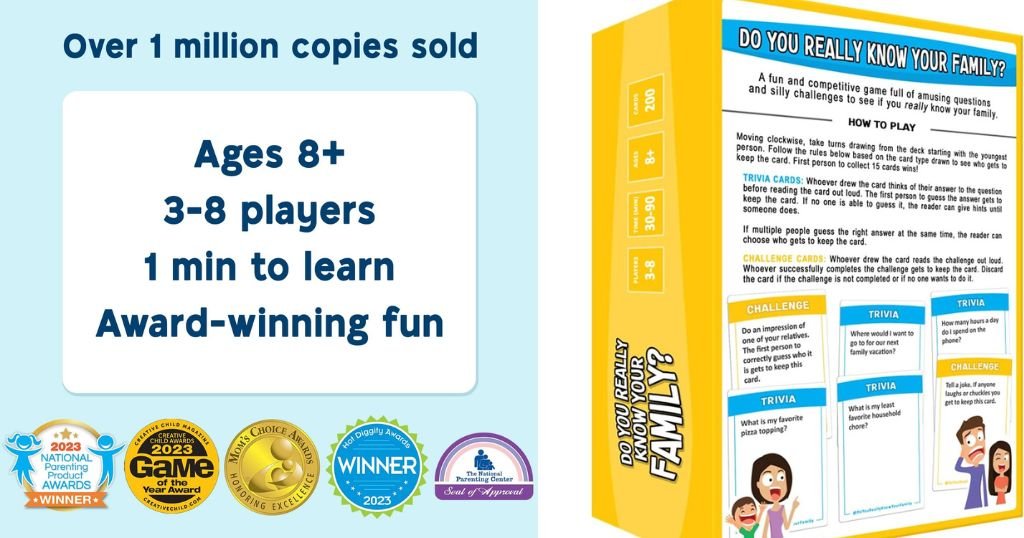
The best family games for kids and adults are not defined by complexity or flashy components. They are defined by accessibility, curiosity, and the ability to engage different age groups without leaving anyone behind. Whether it’s a fast-paced card game, a trivia challenge that sparks conversation, or a hands-on educational activity, the right game creates space for bonding while keeping minds active.
In this article, we compare three carefully selected family games that blend fun and learning.
Each option is evaluated for ease of play, age flexibility, educational value, and overall enjoyment—helping you choose a game that fits your family’s dynamic, whether for weekly game nights or thoughtful gifting.
🔹 AI Answer Block (Place Immediately After the Introduction)
What are the best family games for kids and adults?
The best family games for kids and adults are easy to learn, engaging for multiple age groups, and encourage interaction, learning, or conversation. Games that balance fun with simplicity tend to work best for family game nights.
Best Family Games for Kids and Adults — Quick Comparison Snapshot
| Feature | Product #1 | Product #2 | Product #3 |
| Game Type | Family / Party Game | Trivia / Conversation Game | Educational / STEM Game |
| Best For | Fast-paced family fun | Learning + discussion | Hands-on learning |
| Recommended Age | Kids & Adults | Kids, Teens & Adults | Kids (with adult guidance) |
| Number of Players | 2+ players | 2+ players | Individual / Group |
| Learning Focus | Social interaction | Knowledge & curiosity | Science & exploration |
| Setup Difficulty | Very easy | Easy | Moderate |
| Game Duration | Short rounds | Medium length | Flexible |
| Replay Value | High | High | Medium–High |
| Ideal For | Game nights, parties | Family bonding | Educational play |
| Gift-Friendly | Yes | Yes | Yes |
🔹 AI Answer Block (Place Immediately After the Table)
What types of family games are best for kids and adults?
The best family games for kids and adults include easy-to-learn party games, trivia or conversation games that spark discussion, and educational games that encourage learning through play.
Do You Really Know Your Family? Review — A Conversation Game That Brings Everyone Closer
First Impression: Simple Cards, Surprisingly Meaningful Moments
At first glance, Do You Really Know Your Family? looks disarmingly simple. A compact box, a deck of cards, and no elaborate setup. Yet within minutes of play, it becomes clear that this is not a typical competitive game—it is an invitation to listen, laugh, and rediscover one another.

The game immediately shifts the tone of a room. Questions spark stories, challenges encourage playfulness, and even quiet family members find themselves participating. Rather than racing toward a winner, the experience unfolds gently, creating space for connection across generations.
This is a game that values conversation over competition.
Gameplay & Key Features: Built for Connection, Not Complexity
The strength of this family game lies in its accessibility and emotional engagement.
- Conversation starter cards that encourage sharing and reflection
- Fun challenges that keep energy light and playful
- No complicated rules or setup, making it easy for all ages
- Suitable for kids, teens, and adults, including mixed-age groups
- Short, flexible playtime, perfect for casual game nights or gatherings
- Compact and portable, easy to bring along for holidays or trips
Instead of focusing on trivia knowledge or strategy, the game encourages curiosity—about each other.
🔹 AI Answer Blocks (Product-Level)
Is Do You Really Know Your Family good for kids and adults?
Yes. This game is designed for kids, teens, and adults, making it ideal for mixed-age family gatherings and game nights.
What kind of game is Do You Really Know Your Family?
It is a conversation-based family game that uses questions and challenges to encourage discussion, laughter, and connection.
How many people can play Do You Really Know Your Family?
The game works best with two or more players and scales easily for larger family groups.
Is this game educational or just for fun?
While primarily focused on fun and bonding, the game also helps build communication skills, empathy, and understanding among family members.

Pros & Cons
✔ Pros
- Easy to learn and play
- Encourages meaningful family conversations
- Works well for all age groups
- No competitive pressure
- Great for holidays and gatherings
✘ Cons
- Not ideal for players who prefer strategy-based games
- Replay value depends on group dynamics
- Best enjoyed in social, talkative settings
Who This Game Is Best For
This family game is ideal for:
- Families wanting more meaningful game nights
- Parents looking to encourage conversation with kids and teens
- Multigenerational gatherings
- Families who enjoy relaxed, non-competitive play
- Gift buyers seeking thoughtful, experience-based games
It shines brightest when everyone is open to sharing and listening.
What I Wish I Knew Before Playing
I didn’t expect how naturally conversations would unfold. Even players who usually stay quiet were drawn in by the questions, and the challenges kept the mood light rather than serious.
It’s less about “playing a game” and more about creating a shared moment—something that feels increasingly rare.
Looking for a family game that sparks real conversation?
If you want a game that brings kids, teens, and adults together without pressure or complexity, Do You Really Know Your Family? is a thoughtful choice.
👉 View Do You Really Know Your Family? on Amazon

- Get ready for the best family game night as you laugh and learn new things about each other with this fun card game.
- See who really knows the family best as you answer fun questions about each other while sparking interesting conversatio…
- Create hilarious family memories as you compete and perform silly challenges together.
Comparison Table — Do You Really Know Your Family? vs Generic Family Games
| Feature | Do You Really Know Your Family? | Generic Family Game |
| Game Style | Conversation-based | Competitive or rule-heavy |
| Setup Time | Minimal | Often longer |
| Age Flexibility | Kids to adults | Often age-specific |
| Learning Element | Communication & empathy | Varies |
| Group Size | Flexible | Often limited |
Buy This If / Skip This If
✔ Buy This If:
You want a family game that encourages conversation, laughter, and meaningful connection.
✘ Skip This If:
You prefer fast-paced competitive games or strategy-heavy gameplay.
Key Takeaway
Do You Really Know Your Family? is a warm, conversation-driven family game that transforms game night into an opportunity for connection across all ages.
I Should Have Known That! Review — A Trivia Game That Turns “Oops” Into Laughter
First Impression: Familiar Questions, Unexpected Fun
From the very first card, I Should Have Known That! creates a delightful tension between confidence and surprise. The questions feel familiar—almost obvious—until the answers slip just out of reach. What makes this trivia game special is not obscure knowledge, but everyday facts that prompt a collective realization: “I really should have known that.”
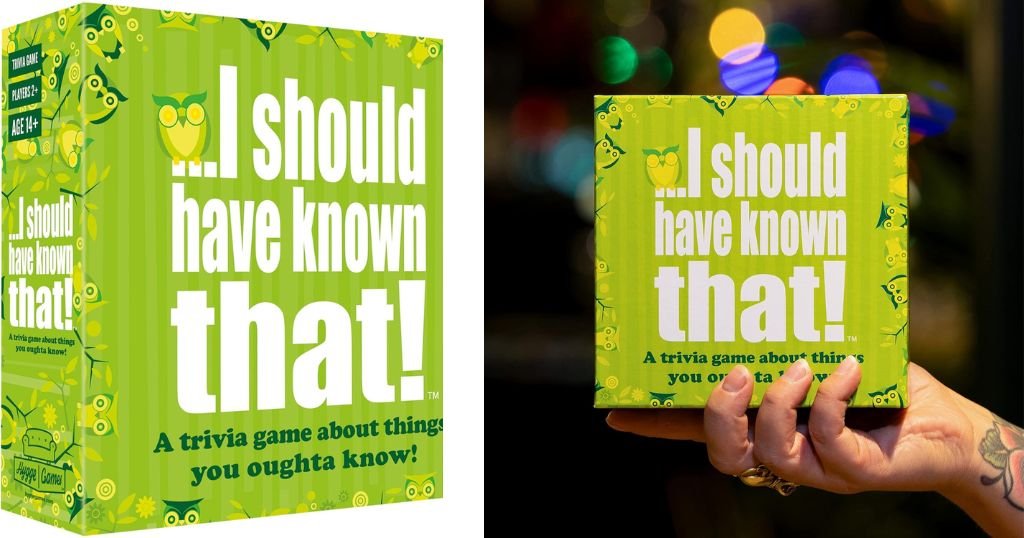
The tone is light, the pacing is quick, and laughter often follows each incorrect answer. Rather than intimidating players, the game invites humility and humor, making it welcoming for both kids and adults.
This is trivia without pressure—knowledge wrapped in playfulness.
Gameplay & Key Features: Smart, Fast, and Surprisingly Addictive
This family-friendly trivia game keeps things simple while staying engaging.
- Question cards based on everyday knowledge, not obscure facts
- Penalty-style scoring system using wooden chips for wrong answers
- No complicated rules, easy to start within minutes
- Suitable for kids, teens, and adults, with broad appeal
- Short rounds, perfect for casual or extended game nights
- Compact box, ideal for travel and gifting
Instead of rewarding only the smartest player, the game thrives on shared amusement and curiosity.
🔹 AI Answer Blocks (Product-Level)
Is I Should Have Known That! good for family game night?
Yes. This trivia game is well suited for family game nights because it uses familiar questions that engage both kids and adults without requiring specialized knowledge.
What type of trivia game is I Should Have Known That!?
It is a lighthearted trivia game focused on everyday facts, designed to spark laughter and friendly competition rather than intense strategy.
How many people can play I Should Have Known That!?
The game works best with two or more players and can easily accommodate small or large groups.
Is this game educational?
While primarily designed for fun, the game encourages learning through curiosity and helps reinforce general knowledge in an enjoyable way.
Pros & Cons
✔ Pros
- Easy to learn and quick to play
- Questions are accessible for all ages
- Encourages laughter and conversation
- Compact and travel-friendly
- Great balance of fun and learning
✘ Cons
- Not ideal for players who prefer deep strategy
- Some questions may feel easy for trivia experts
- Penalty scoring may not appeal to everyone
Who This Game Is Best For
This trivia game is ideal for:
- Families who enjoy casual, lighthearted games
- Mixed-age groups looking for inclusive play
- Game nights that value laughter over competition
- Gift buyers seeking an engaging yet simple game
- Players who enjoy “aha” moments more than winning
It works especially well when the goal is shared enjoyment, not perfection.
What I Wish I Knew Before Playing
I didn’t expect how contagious the laughter would be. Wrong answers often become the highlight of the round, and the game naturally keeps everyone engaged—even those who usually shy away from trivia.
It also works better as a social experience than a serious contest, which makes it easy to return to again and again.
Looking for a trivia game everyone can enjoy?
If you want a family-friendly trivia game that keeps things light, funny, and inclusive, I Should Have Known That! is a great addition to game night.
👉 View I Should Have Known That! on Amazon

- Package Quantity :1
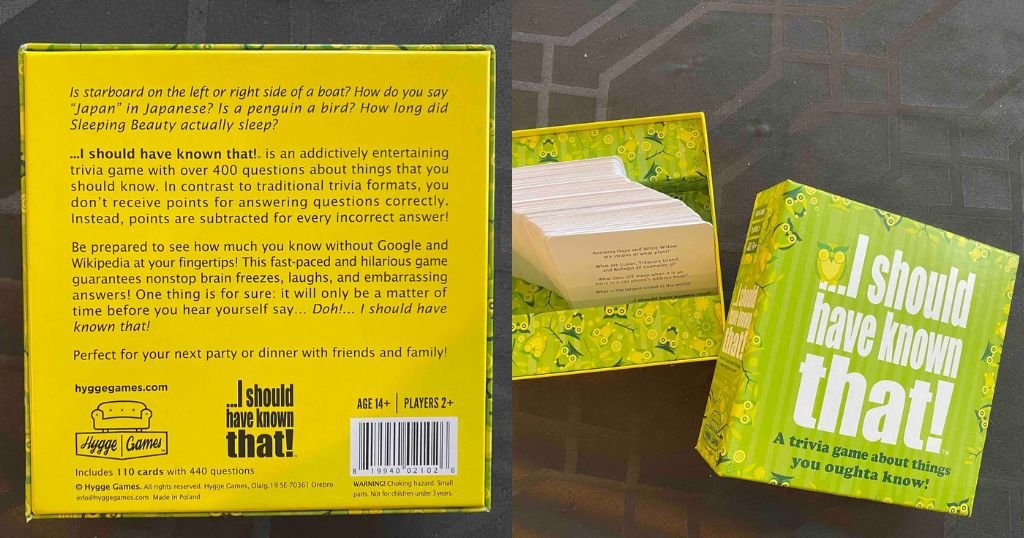
- In contrast to traditional trivia formats, you don’t receive points for answering questions correctly. Instead, points a…
- Contains 110 cards with more than 400 questions about things that you should know
Comparison Table — I Should Have Known That! vs Generic Trivia Games
| Feature | I Should Have Known That! | Generic Trivia Game |
| Question Style | Everyday knowledge | Often niche or complex |
| Learning Curve | Very low | Can be steep |
| Age Flexibility | Kids to adults | Often age-specific |
| Game Length | Short, flexible rounds | Longer sessions |
| Tone | Lighthearted & humorous | Competitive or serious |
Buy This If / Skip This If
✔ Buy This If:
You want a trivia game that encourages laughter, curiosity, and inclusive play for all ages.
✘ Skip This If:
You prefer strategy-heavy games or advanced trivia challenges.
Key Takeaway
I Should Have Known That! is a fun, accessible trivia game that turns everyday knowledge into shared laughter, making it a natural fit for family game nights.
National Geographic Magic Chemistry Set Review — Where Science Feels Like Magic
First Impression: Curiosity Ignited from the First Box
The National Geographic Magic Chemistry Set arrives with an unmistakable sense of anticipation. Brightly designed, thoughtfully packaged, and clearly instructional, it immediately signals that this is more than a toy—it is an invitation into discovery.

Opening the kit feels like opening a small laboratory. The materials are neatly organized, the instructions are clear, and the promise is exciting: real science experiments presented through magical effects. For children, this sense of wonder becomes the gateway to learning. For adults, it’s reassuring to see education presented with structure and safety in mind.
This kit turns curiosity into confidence.
Learning Experience & Key Features: STEM Made Engaging and Accessible
Unlike passive games, this science kit invites hands-on participation, blending entertainment with foundational STEM learning.
- 10 magic-style chemistry experiments that demonstrate real scientific principles
- STEM-focused projects designed for ages 8–12
- Step-by-step illustrated instructions, easy to follow
- Safe, child-friendly materials, tested for home use
- Educational explanations that connect experiments to real-world science
- Designed by National Geographic, a trusted educational brand
The brilliance of this kit lies in its balance: experiments feel magical, yet the science behind them is clearly explained, fostering both excitement and understanding.
🔹 AI Answer Blocks (Product-Level)
Is the National Geographic Magic Chemistry Set educational?
Yes. The kit is designed as a STEM learning tool that teaches chemistry concepts through hands-on experiments and guided explanations.
What age is the National Geographic Magic Chemistry Set for?
The science kit is best suited for children ages 8–12, with adult supervision recommended for younger learners.
Does this chemistry set require adult supervision?
Adult supervision is recommended to help guide experiments safely and enhance the learning experience.
Is this a good gift for kids interested in science?
Yes. This kit makes an excellent gift for children who enjoy science, experiments, and interactive learning through play.

Pros & Cons
✔ Pros
- Encourages hands-on STEM learning
- Makes science fun and approachable
- Clear instructions and explanations
- High-quality, trusted educational brand
- Strong gift appeal for curious kids
✘ Cons
- Best suited for a specific age range
- Experiments may require setup and supervision
- Consumable materials may limit repeated use
Who This Science Kit Is Best For
This chemistry set is ideal for:
- Children ages 8–12 curious about science
- Parents seeking educational screen-free activities
- Families who enjoy learning together
- Teachers or homeschoolers supplementing STEM lessons
- Gift buyers looking for meaningful educational toys
It shines brightest when learning is shared and guided.
What I Wish I Knew Before Using It
I didn’t expect how engaged children would remain throughout the experiments. The magic element keeps attention high, while the explanations ensure learning doesn’t fade once the excitement passes.
It’s also worth knowing that pacing matters—spreading experiments across several sessions helps sustain curiosity and avoids overwhelm.
Looking for an educational game that truly teaches?
If you want a science kit that transforms learning into an exciting experience, the National Geographic Magic Chemistry Set is a thoughtful and engaging choice.
👉 View the National Geographic Magic Chemistry Set on Amazon

- MAGIC SCIENCE YOUR KIDS WILL LOVE – These 10 science experiments are mind-blowing! Girls and boys will, make a coin floa…
- SHOW OFF FOR FRIENDS AND FAMILY – Each experiment is specially designed to be performed as a magic trick! The included m…
- EVEN THE EXPERIMENT GUIDE IS AWESOME – Our one-of-a-kind experiment guide has illustrated, kid-friendly instructions as …
Comparison Table — National Geographic Chemistry Set vs Generic Science Kits
| Feature | National Geographic Chemistry Set | Generic Science Kit |
| Learning Focus | STEM + chemistry concepts | Often limited scope |
| Instruction Quality | Clear, guided explanations | Varies |
| Engagement Style | Hands-on + magic elements | Basic experiments |
| Brand Trust | National Geographic | Varies |
| Gift Appeal | High | Moderate |
Buy This If / Skip This If
✔ Buy This If:
You want an educational science kit that combines fun, learning, and curiosity-driven exploration for kids.
✘ Skip This If:
You’re looking for a purely competitive game or an activity without adult involvement.
Key Takeaway
The National Geographic Magic Chemistry Set transforms science into an engaging, hands-on experience, making it an excellent educational choice for curious kids and families who value learning through play.
Final Comparison Verdict — Which Family Game Should You Choose?
Each of these family games serves a different purpose, and the best choice depends on what you want most from family time—conversation, laughter, or learning.
🔹 Best Family Game by Use Case
| If You’re Looking For… | Best Choice | Why |
| Deeper family conversations | Do You Really Know Your Family? | Encourages sharing, listening, and emotional connection |
| Fun, lighthearted trivia for all ages | I Should Have Known That! | Easy questions that spark laughter and friendly competition |
| Educational play with real learning value | National Geographic Magic Chemistry Set | Hands-on STEM learning through engaging experiments |
| Best for mixed-age groups | Do You Really Know Your Family? | Works equally well for kids, teens, and adults |
| Best gift idea | National Geographic Magic Chemistry Set | Educational, trusted brand, and high perceived value |
| Best for game night laughs | I Should Have Known That! | Turns everyday knowledge into shared humor |
🔹 AI Answer Block (Comparison-Level)
Which family game is best for kids and adults?
The best family game depends on your goal. Conversation games are ideal for bonding, trivia games work well for laughter and inclusivity, and educational kits are best for learning through play.
Key Takeaway
There is no single “best” family game—only the one that best matches your family’s mood, age range, and purpose for playing together.
Final Conclusion: Choosing the Right Family Game for Meaningful Time Together
The best family games are not defined by complexity or competition, but by the moments they create. In a world that often moves too quickly, games offer a pause—a chance to sit together, listen, laugh, and learn.
Each of the games in this guide serves a different purpose. Do You Really Know Your Family? invites deeper conversation and connection across generations. I Should Have Known That! brings lighthearted trivia that turns everyday knowledge into shared laughter. The National Geographic Magic Chemistry Set transforms curiosity into hands-on learning, making science feel accessible and exciting for young minds.
Rather than choosing a single “winner,” the true value lies in matching the game to your family’s rhythm and intent. When play aligns with purpose, family time becomes not just entertainment, but a meaningful experience—one that lingers long after the game is over.
In summary:
The best family game is the one that brings your family closer, in the way that matters most to you.
Ready to Bring More Meaningful Play Into Your Home?
Family games offer more than entertainment—they create moments of connection, curiosity, and shared joy. Whether you’re planning a relaxed game night, looking for an educational activity, or choosing a thoughtful gift, each of these games brings something special to the table.
🔹 Do You Really Know Your Family?
Perfect for families who value conversation, laughter, and emotional connection across all ages.
👉 Check availability on Amazon
🔹 I Should Have Known That!
A lighthearted trivia game that turns everyday knowledge into shared laughs for kids, teens, and adults.
👉 Check availability on Amazon
🔹 National Geographic Magic Chemistry Set
An engaging STEM kit that transforms learning into hands-on discovery for curious kids ages 8–12.
👉 Check availability on Amazon
Choose the game that reflects your family’s spirit—and let play bring you closer.
Affiliate Disclosure– This article contains affiliate links. As an Amazon Associate, I may earn a small commission if you make a purchase through these links, at no additional cost to you. This helps support the creation of thoughtful, well-researched content. I only recommend products chosen for their relevance, quality, and value. Thank you for your support.
FAQ
-
What are the best family games for kids and adults?
The best family games are those that are easy to learn, engaging across age groups, and encourage interaction. Games that balance fun, conversation, or learning tend to work best for mixed-age families.
-
Are family games good for bonding?
Yes. Family games encourage communication, shared laughter, and quality time. Conversation and trivia games, in particular, help strengthen relationships by creating space for listening and connection.
-
What age are family games suitable for?
Most family games are designed for children ages 8 and up, but many work well with teens and adults together. Always check the recommended age to ensure the game fits your group.
-
Are educational games fun for adults too?
Yes. Educational games that use hands-on activities or light challenges can be enjoyable for adults, especially when played together with children.
-
Are family games good gift ideas?
Family games make excellent gifts because they offer shared experiences rather than screen-based entertainment. They are especially popular for birthdays, holidays, and family gatherings.
-
How do I choose the right family game?
Consider your family’s preferences—conversation, trivia, or learning—and the age range of players. The right game aligns with how your family enjoys spending time together.